P / 01 passed
Ordinary tests
Examples, edge cases, distributions, cancellation, and transactional failure behavior across the workspace.
240 authored test entry points01 The control loop
Composable Rust primitives for selection, affinity, health, discovery, and dispatch. Six ownership boundaries, drawn once, so the whole request path is legible before you write a line against it.
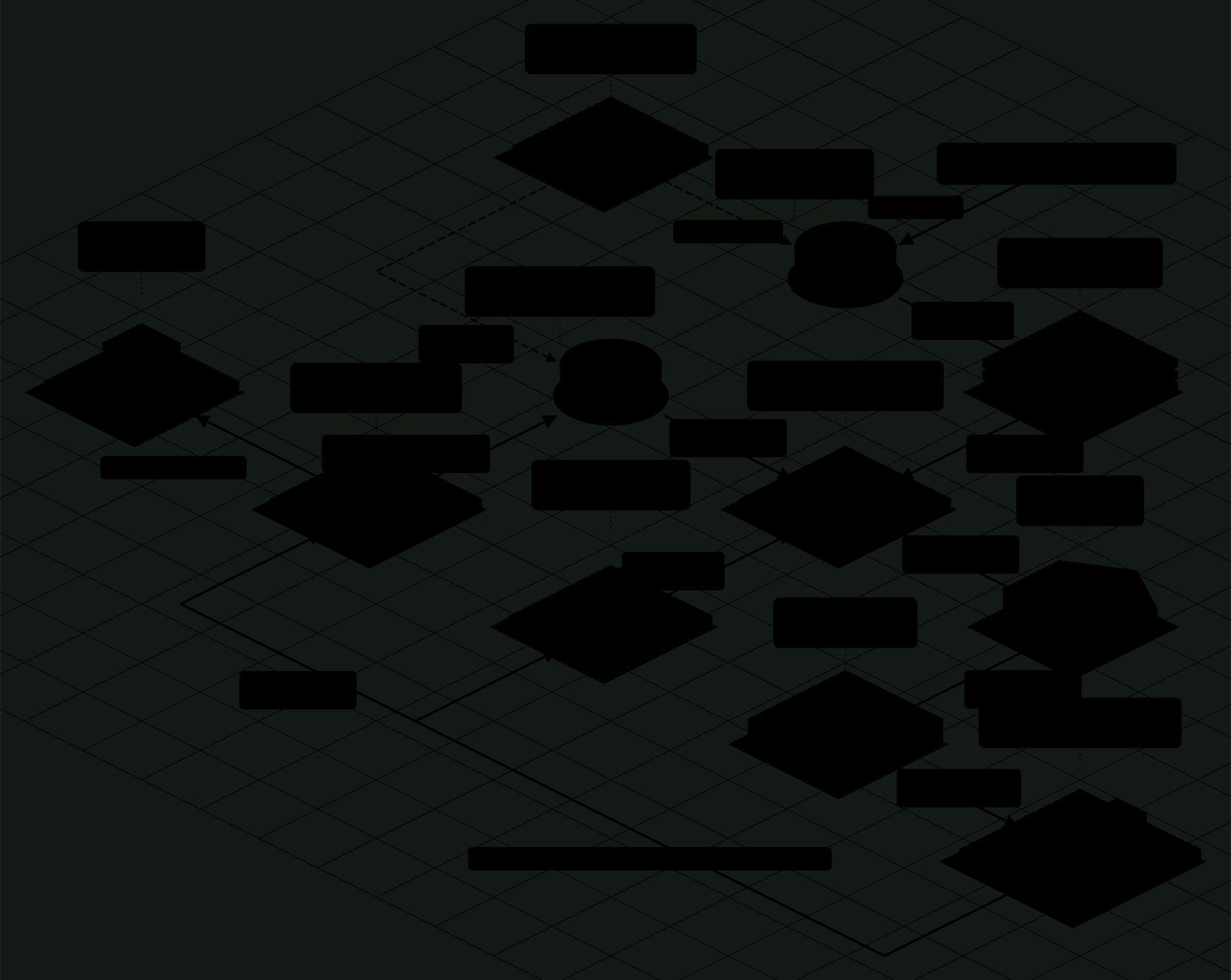
02 The invariant orrery
The same primitives as a live field: each capability in orbit, replayed against the verification layer that currently holds it.
← → step · space pause · 1–7 focus
03 / The premise
Selection is only the visible moment. Poise makes every force around it explicit.
Membership. Eligibility. Choice. Dispatch. Feedback. Each concern has a boundary you can inspect, compose, and replace.
04 / Capability atlas
Select a family to reorganize the orrery. The same symbolic language describes the primitive, its state, and the proof currently exercising it.
05 / Verification ledger
Recorded local baseline
Awaiting verification data
P / 01 passed
Examples, edge cases, distributions, cancellation, and transactional failure behavior across the workspace.
240 authored test entry pointsP / 02 passed
Generated inputs test selection safety, minimal disruption, exact replay, conservation, and topology metadata.
3,584 generated cases per runP / 03 passed
The suite must reject every terminating, viable behavioral mutation. Equivalent rewrites are reviewed, never hidden.
0 viable survivors / 642 sitesP / 04 passed
Exhaustive scheduler exploration checks in-flight accounting and health-state transitions under hostile interleavings.
6 scheduler modelsP / 05 passed
The dependency graph and public surface are held to the declared Rust 1.85 minimum supported version.
1.85 declared Rust MSRV06 / Composition path
use poise_core::{Backend, Policy, policy::RoundRobin};

let backends = [Backend::new("a"), Backend::new("b")];
let mut policy = RoundRobin::new();

let selected = policy.pick(&backends, &())?;
07 / Begin with the contracts